
Passenger Counting for Metros: Distinguish Train-Door Counts from Station Entries
Metro operators usually have more than one passenger count. Automatic fare collection (AFC) gates record passengers entering and leaving each station. Automatic Passenger Counting (APC) sensors above train doors record passengers boarding and alighting at each stop.
Both are called passenger counts, but they measure different things. Station entries measure journeys that start at a station. Train-door counts measure how passengers use the trains. Mixing the two leads to totals that do not match and comparisons that do not mean what they appear to mean.
What station entries measure
An AFC gate records a validation when a passenger enters the paid area and, on systems with exit validation, another when the passenger exits. Gate data shows:
- entries and exits by station, gate group, and time of day;
- the origin and destination station of each journey, where exit validation is required; and
- ticket or card type, which links demand to fares and revenue.
Gate data does not show what happens inside the paid area. Researchers studying metro smart-card data note that only each trip’s tap-in and tap-out times and stations are recorded directly; the train and route a passenger chose are unknown . Operators can estimate them with models, but the gates do not count them.
What train-door counts measure
Door-mounted APC sensors count passengers crossing each door of an equipped train. Because each count is tied to a train, a car, a door, and a station stop, the data shows:
- boardings and alightings at each station, by train and direction;
- the load between consecutive stations, calculated from those movements;
- the busiest section of the line for each train or time period; and
- how passengers are distributed between cars and doors.
Door counts include every passenger who boards a train, whether that person entered through the station gates or changed from another line.
Why the totals differ
The clearest difference appears at interchanges. A passenger who changes lines without leaving the paid area passes the gates once but boards two trains.
Take one illustrative journey. A passenger enters at Station A on Line 1, changes to Line 2 at Station B, and exits at Station C:
- Gates record one entry at A and one exit at C.
- Train doors record a boarding at A, an alighting and a boarding at B, and an alighting at C.
Across a network with many interchanges, the gap becomes large. In March 2019, Delhi Metro responded to reports of falling ridership by noting that its ridership of over 27.26 lakh in February 2019 understated use of the network, and that line utilisation was over 50 lakh . DMRC attributed the difference to the growth in interchange stations, from 10 to 26, which let existing passengers use more lines.
Other differences are smaller but matter for detailed analysis:
- Timing. A gate entry happens minutes before boarding. When platforms are crowded, a passenger may wait for several trains. Entries and boardings in the same 15-minute window will not match.
- Coverage. Gates cover every station. APC may be fitted to part of the fleet, so door counts often need to be expanded from a sample of trains.
- Definitions. Published figures may report entries, journeys, or line-level use. A comparison is only valid when both sides use the same unit.
Use each count for the question it answers
Each count is strongest for a different set of decisions.
Station entries and exits suit questions about stations and fares: gate capacity, entrance demand, catchment, origin-destination patterns, and revenue.
Train-door counts suit questions about service: peak load sections, train frequency and length, crowding by car, boarding activity at busy doors, and how many passengers change at each interchange.
Some questions need both. Interchange flows, for example, can be estimated by comparing door boardings at an interchange station with gate entries at the same station over the same period.
Reconcile the two before comparing them
Before combining gate and door data, teams should:
- label every figure with its unit: entries, exits, boardings, alightings, or line journeys;
- align station codes, operating days, and time windows;
- compare door boardings with gate entries at non-interchange stations, where the two should be close, to check APC coverage and expansion;
- expect door boardings to exceed gate entries at interchange stations, and investigate the size of the difference rather than the fact of it; and
- exclude trains with incomplete door data or device faults before expanding sample counts.
A gap between two metro counts is not necessarily an error. It is often the difference between how many journeys started and how passengers actually used the trains.
Explore how WEBREATHE applies Automatic Passenger Counting to metros, buses, and trains , or read how passenger counting improves flow at transit stations .
Sources: Team MP, “DMRC clarifies its stand over declining Metro ridership” , Millennium Post, 28 March 2019; Zhao et al., “Estimation of Passenger Route Choice Pattern Using Smart Card Data for Complex Metro Systems” , arXiv:1605.08390.
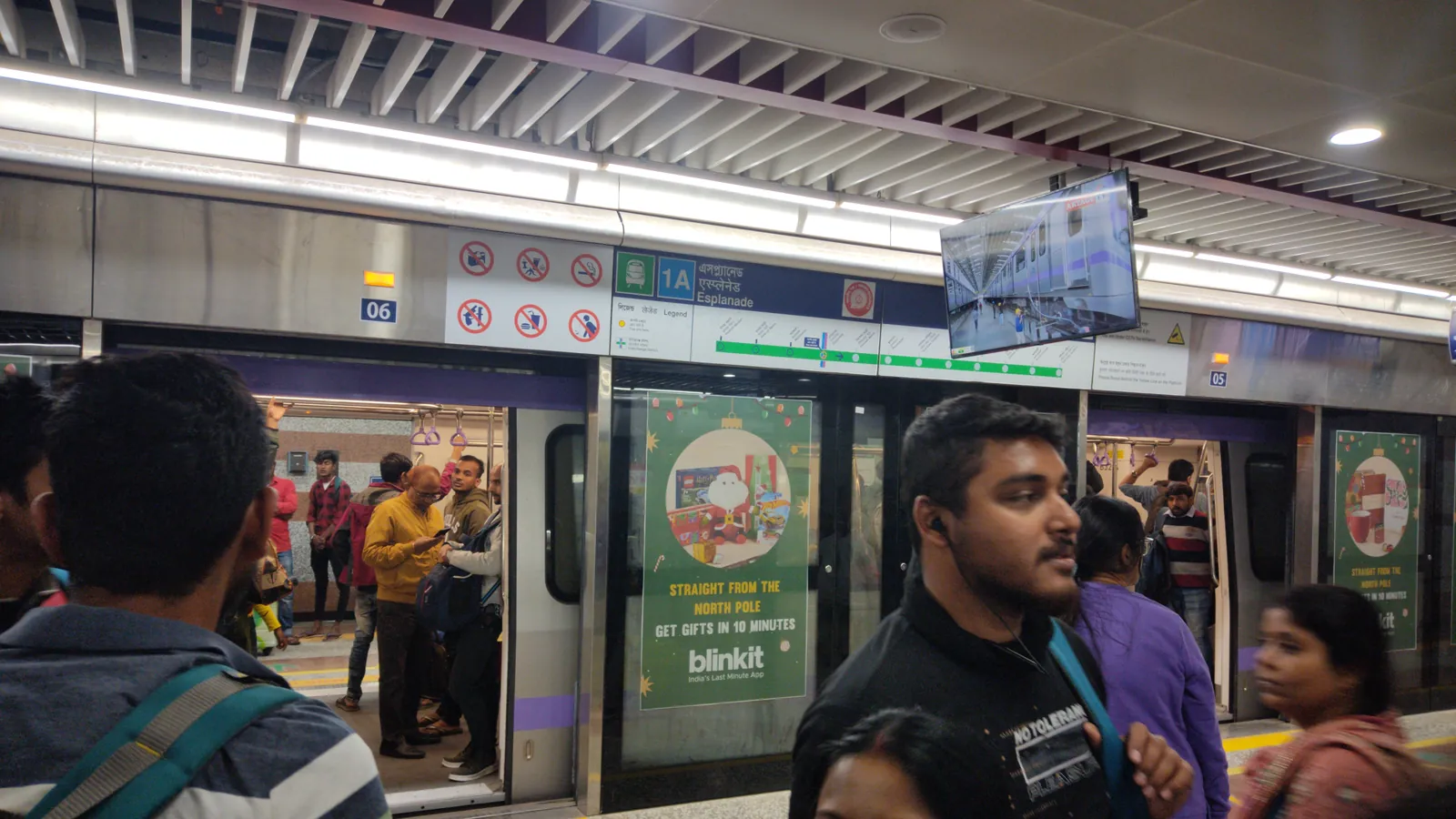
Image: Esplanade metro station, Kolkata, by Projjalm via Wikimedia Commons , CC0.